 Charonyu
Does AI mock interview practice actually help? How to use AI to prepare for interviews
AI mock interviews are good for repetition and tightening how you tell your experience, but they can't replace real-person pressure or industry judgment. What AI does well, a practice routine that works, and privacy checks.
 Charonyu・Article・

Quick answer
AI mock interviews help, but within limits. They are good at generating questions from a job description, letting you practice speaking at any time, showing in a transcript where an answer rambles or lacks results, and letting you repeat weak questions until they come out smoothly. They are not good at judging how much your experience is worth in your industry, and they can’t fully reproduce the pressure of a real interview, so you need to judge their scores and suggestions yourself. An effective routine is: generate questions from a real job description → answer with the STAR structure → revise from the transcript → redo your weak questions, and check how your data is handled before you start.
What are AI mock interviews good at?
- Practice any time: no need to schedule anyone. Run a round at midnight or before your commute.
- Questions based on the job: give it the job description and it asks about the actual duties and requirements, which is closer to reality than memorizing a generic question bank.
- No fatigue, no embarrassment: you can practice the same question five times without worrying about bothering someone.
- Structure check: it can point out whether you covered the situation, your actions and the result, or whether an answer is too long or off topic.
- Transcripts: turning your speech into text makes filler words (“so”, “like”, “um”) easy to spot, along with places where you spent three minutes without reaching the point.
What are AI mock interviews not good at?
- Real judgment from inside the industry: whether your project results look impressive in this field, or whether your salary expectation is reasonable, is something AI may not judge accurately.
- Live pressure: how you react to a real person who interrupts or challenges you is hard to train with AI.
- Nonverbal performance: eye contact, posture, tone and dress are not covered by most voice or text practice.
- Company culture and inside information: what a specific team cares about or how an interviewer behaves has to come from public company information or people you know.
- Feedback isn’t always right: AI may give advice that sounds reasonable but doesn’t suit you, or misunderstand your answer.
How to prepare with AI so it actually works
1. Generate questions from a real job description
Don’t only practice generic questions like “Tell me about yourself” or “What is your weakness?” Use the job’s duties, required qualifications and nice-to-haves as the basis for questions, so they match what you’ll really be asked.
2. Answer behavioral questions with the STAR structure
For prompts like “Describe a time you solved a problem”, organize your answer with STAR:
- S (Situation): the background, in a sentence or two.
- T (Task): what you were responsible for and what the goal was.
- A (Action): what you specifically did. Spend the most time here.
- R (Result): the outcome, ideally with numbers or a concrete change.
3. Revise from the transcript, not just the score
A score is only a reference. What really helps is going back through the transcript: where you talked too long, where the result is missing, which example has nothing to do with the job. Write down what to change and deliberately fix it next time.
4. Redo your weak questions
After each session, pick the 2–3 questions you did worst and redo them first in the next round. Getting weak questions smooth shows more progress than always practicing new ones.
5. Do at least one session with a real person
Once your structure is clear with AI, ask a friend, a senior colleague or a career counselor to run one full mock interview, to practice live reactions and delivery.
Privacy to check before you start
An AI mock interview usually needs to send your answers, resume content or job information off for analysis. Before using one:
- Read the consent notice: what data is sent, what it is used for, and where it is stored.
- Remove unnecessary personal data: phone number, email, home address and national ID number don’t need to be given to an AI.
- Avoid company secrets: describe a former employer’s internal figures or unannounced project names in general terms instead.
- Recording environment: during voice practice, make sure you don’t record other people’s conversations.
Practicing with Job Pocket based on the job and your resume
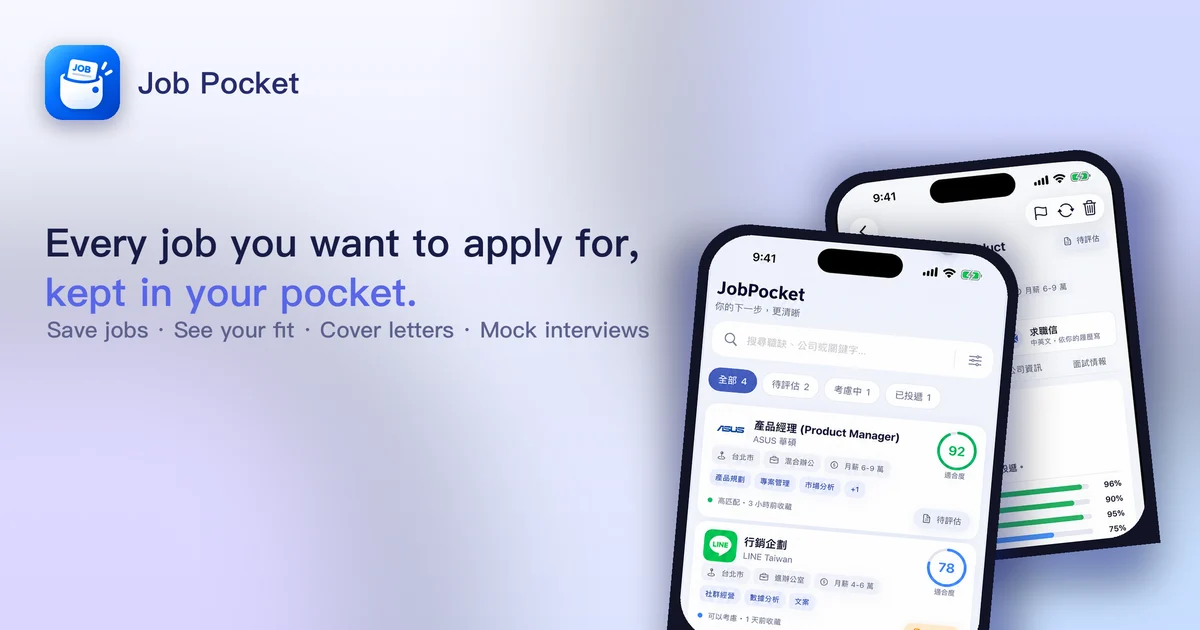
Job Pocket is an app for saving jobs, organizing job highlights and tracking application progress (see How to organize job listings and application progress when you apply to many companies). Before an interview you can continue like this:
- Interview notes: one page per job with preparation reminders, a company overview and questions you may be asked. The mock interviewer also refers to the same content.
- Voice mock interview: questions are based on your resume and the job. You answer by speaking, one question per round, with live captions while you talk. You can choose from four interviewers (Evan, Kevin, Guoyu, Anna) and between an “interviewer view” and a “text chat” view.
- Written report: after the interview you get per-question suggestions and scores, and you can redo the weak questions.
- Resume cleanup: import a text-based PDF or plain text file, check it, and it is only saved after you confirm. You can also edit it by hand.
- Storage and sending are separate: jobs, resume fields, transcripts and reports are stored on your phone. AI analysis and the voice mock interview need to send the relevant content (including your voice recording) out for processing, and the app explains how the data is used and asks for your consent first. See the privacy policy for details. These features are for users 18 and older.
- Pricing: the free plan includes 25 job analyses per calendar month (shared with resume cleanup), 3 cover letters and one 2-question mock interview trial. Pro includes 200 analyses, 200 cover letters and 8 full mock interviews per month, for NT$180 per month or NT$1,490 per year. The actual price is shown on the App Store purchase screen.
The first question is usually a self-introduction, so start with How to prepare an interview self-introduction: a 1-minute example and structure.
Tip: practice until you can hit the key points without reading a script, and stop there. Don’t memorize word for word. Interviewers mostly follow up on details, and memorized answers are the easiest to get stuck on.
Disclosure: Job Pocket is an app developed by this site's author (Charonyu). The built-in methods and other options described here all work without downloading our app.
FAQ
Can AI mock interviews replace practicing with friends or mentors?
Not completely. AI is great for lots of repetition and tidying up your answer structure. A real person gives you live pressure, real judgment from inside your industry, and feedback on body language. Use both.
Can I memorize the sample answers AI gives me?
We don't recommend it. A suggested answer is only a structure to borrow. Replace the content with your own real experience and numbers, otherwise a single follow-up question from the interviewer can expose it.
What privacy issues should I watch for when practicing interviews with AI?
Check what data is sent and what it is used for. You don't need to give an AI the phone number, email, address or national ID number on your resume, and you should avoid confidential company information or a former employer's internal figures.
How many practice rounds are enough?
There's no fixed number. A practical goal is that you can answer the common questions in 1–2 minutes with a clear structure and without reading a script, and that the questions you did badly on last time have improved.
Does the mock interview in Job Pocket cost money?
The free plan includes one 2-question voice mock interview each calendar month. Pro includes 8 full mock interviews per month (about 15–20 minutes and 5–8 questions each) for NT$180 per month or NT$1,490 per year. The actual price is shown on the App Store purchase screen.